
Burn Your Oracles
Burn Your Oracles
How does a surgeon make life-and-death decisions in seconds? How does an investor find the conviction to risk billions on a single idea?
When ordinary lives are filled with decisions of extraordinary importance, how do we actually live?
Talk to practitioners at the outer edges of competence and you’ll hear a specific story. Attend an investor’s AGM and you’ll hear about “decision science.” Sit in on a surgical conference and you’ll hear of “decision support.”
Take them at their word and the hardest choices in the world are easy. Our best professionals are simply following the checklist. Greatness is just the byproduct of following instructions, obeying risk guidelines, “just doing the work.”
I don’t believe them. Almost all the infrastructure we build around these practitioners is training wheels that never touch the ground.
We dress up hard decisions in scientific language because we’re terrified of the reality: our lives and our economy rest on the snap judgments, divine convictions, and table sense of individuals.
We are burying ourselves in increasingly elaborate oracles. The more consequential the decision, the more baroque the framework we invent to pretend we’re not making it.
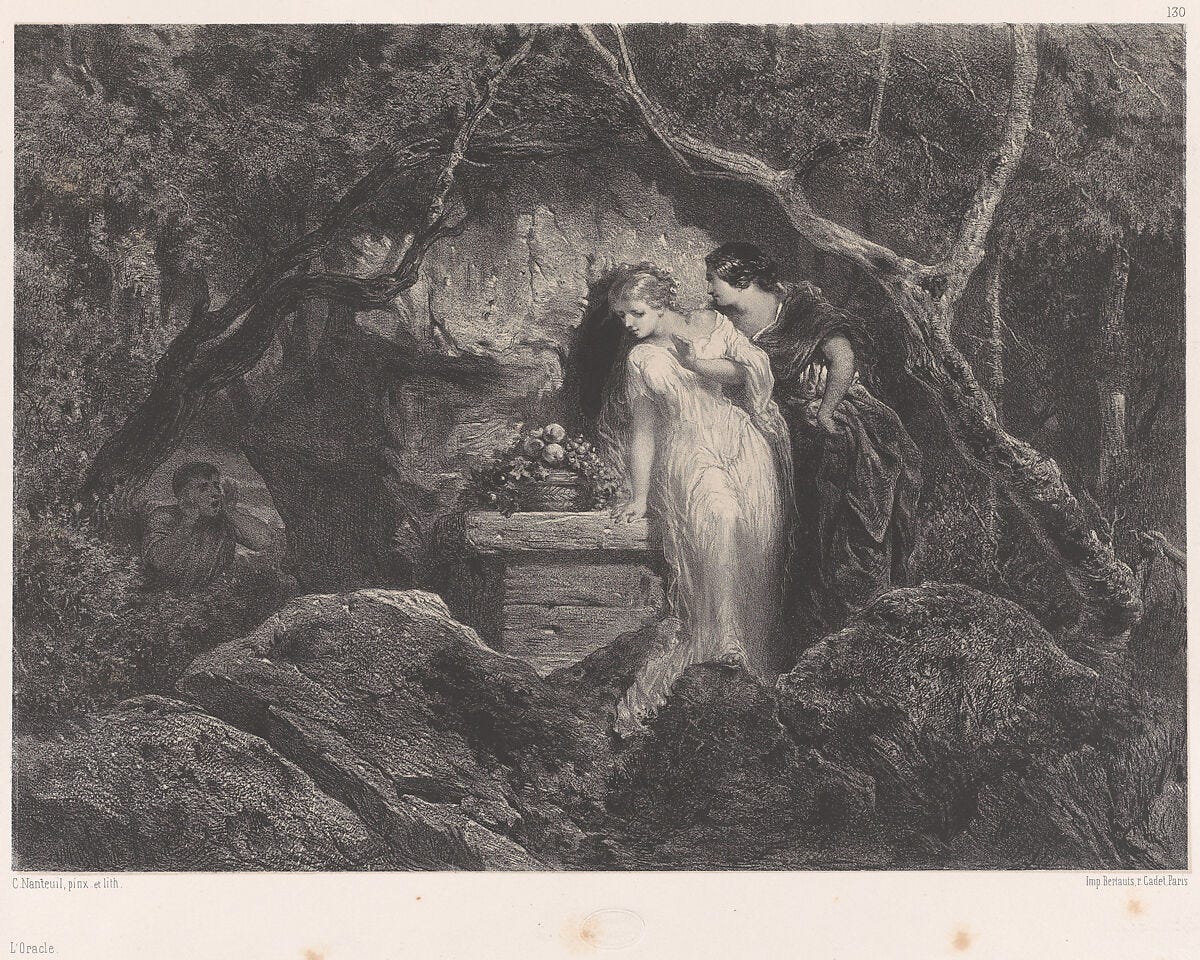
A thousand years ago you’d stare at the sky until you could read the flight of the birds. Today you build an Excel model simulation. The function is the same. Place the weight somewhere other than the person deciding.
I grew up Quaker. Quakers have no priests, no liturgy, and no service. A Quaker meeting for worship is an hour of silence. You sit and wait to hear the “voice of God” which Quakers believe exists within all of us.
Quakers call this central practice “discernment.” You sit in silence until clarity arrives. You wait for “the way forward” to open.
What I’ve come to believe is that discernment is closer to what the best practitioners actually do than any framework they’ll admit to. The surgeon doesn’t follow the decision tree. She waits until something clarifies. The investor doesn’t obey the model. He sits with it until conviction emerges or doesn’t.
The checklist, the framework, the consultant—is the story they tell afterwards. The oracle only exists in retrospect.
LLMs are the most seductive oracles we have ever built. Not because they are smart. Because they are infinitely patient. They will talk to you forever. They will generate frameworks and matrices and pro-con lists until judgment comes.
Every other oracle had friction. The goat had to be slaughtered. The consultant had to be paid. The Monte Carlo simulation took hours to run. But the LLM is frictionless. You can ask it anything, forever, for free.
This is the danger. Not that it gives bad answers. That it gives any answer at all. That it fills the silence where discernment sits.
The hardest part of any real decision is sitting in the discomfort of not knowing. The answer doesn’t come from thinking harder: It comes from staying in the silence long enough for clarity to arrive.
LLMs let us avoid that silence entirely. We can feel like we’re doing something. We can generate options, stress-test scenarios, explore the solution space. We can be busy forever.
But busy is not clear. And clear is the only thing that matters.
Burn your oracles. Sit in the silence. The way will open.
“Source?”
”It was revealed to me in a dream”
gigachad.jpeg
yes, that is because they are not capable of forming hard to vary explanations which require creative conjectures. Also wrote about this here: https://scalingknowledge.substack.com/i/110844323/decisions-as-explanations-choice