
Jump Ball
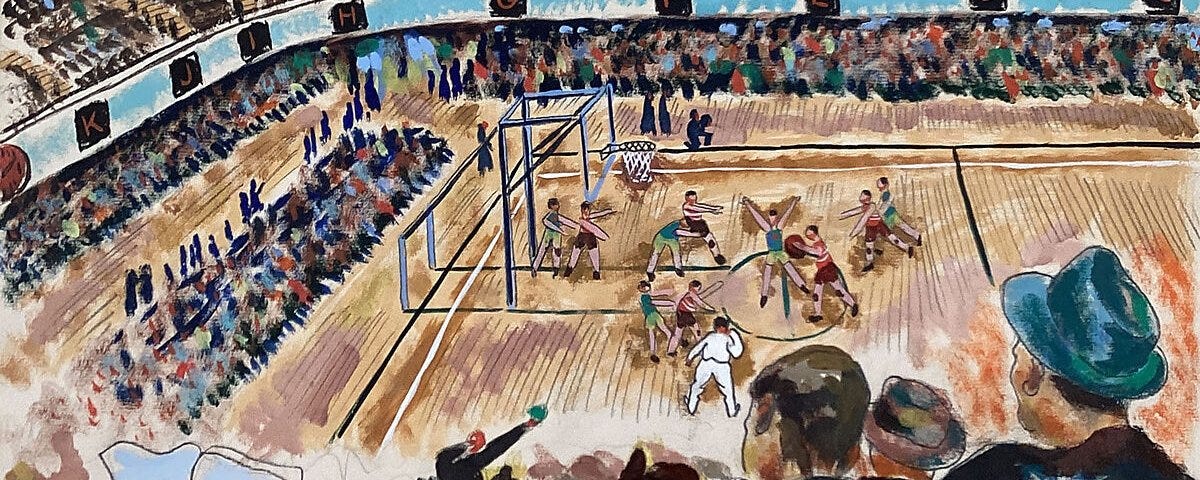
My father, God bless him, pushed me through ten years of recreational basketball as a child. I was always tall for my age but about as unathletic as you could possibly imagine. I don’t have many memories from that era — I think everyone involved has done a good job of collectively blacking it out.
The one memory I do have is the first time I participated in a contested possession. Some other kid and I — seemingly slow enough that I could actually catch him — both had our hands on the ball. The ref blew his whistle repeatedly, trying to get us to separate, but we were locked in a giraffe-necked battle, each trying to wrench it from the other’s grip.
Eventually the ref set up a jump ball. We both lined up, but the only strategy either of us could figure out was to wait until one of us grabbed it and then pummel the other — just openly, in front of parents — until the ball came free again.
The jump ball is one of sports’ strangest inventions. When normal play breaks down and no one can agree on possession, we just throw the ball in the air and see what happens. It’s the only resolution mechanism in any sport that is essentially: let’s just restart and see who wants it more. The ball is loose. The outcome is uncertain. And the only thing that will settle it is raw commitment to getting the ball first.
I’ve been thinking about jump balls because I’m seeing them everywhere — in markets, in media, in the basic shared project of figuring out what’s true. Call it an epistemic jump ball: the moment when the normal mechanisms for establishing truth break down simultaneously across a large number of people. Everyone can see the ball is in the air. No one is quite sure where it’s coming down. And the only thing anyone can think to do, apparently, is beat the other guy senseless.


What’s interesting about the jump ball — the real one, and the metaphorical one — is the psychology of the players waiting underneath it. Both believe it’s theirs. Both also know, somewhere underneath that belief, that they might be wrong. This is what a failure of pricing looks like, whether you’re talking about equities or ideas or convictions. When the ball is in the air, no one has actually been convinced it’s going their way. They’ve just decided to act like it is.
But for the fleeting seconds that it’s in the air and the couple of minutes while we brutalize the other player into the floor before it resolves, we are in something of a free-for-all. There are a tremendous number of these epistemic jump balls, and in the absence of a functioning institutional body, the basic shared project of what’s true about a singular narrative can settle one of them. A secular story can organize a conversation around them for a week, but it can’t organize a civilization around them over decades. The Citrini piece tells you what to think about AI for five days. It can’t tell you what to do for the rest of your life.
I don’t have the energy to critique the Citrini piece anymore. I wrote 15,000 words about English gardening that many of you read -- at least in pieces -- yesterday in response to it. And my dear friend Gokul, who is a deeply serious and considered person, I think is pretty close to a heart attack, refuting the idea that the main function of DoorDash is a mobile app interface.


But I do think it’s a relatively interesting skeleton key to understand the jump ball that exists in markets today. I think across informed and uninformed market participants, there is a simple view that equity prices are too high, and that we’ve priced in a level of AI margin expansion, growth, and fundamental change that has yet to occur. On the other side, with equally informed and uninformed market participants, there is a simple view that equity prices are much too low. And then we have failed to price in the fact that we are mere months away from free silicon intelligence too cheap to even meter, that will usher us into a post-scarcity, peptide-laden, sexless but also deathless communist society.
Even if these are both structurally incoherent views, I think we can agree that equities, or at least mega-cap, high-growth tech equities are not worth exactly what they’re worth today. The mechanisms that we usually use to figure out what that value is— things like earnings, revenue growth, and the amount of money your customers owe you— have given way to vibes. And the vibes point in both directions, with very little in between.
Which means that we are in something of an epistemic jump ball. Instead of allowing possession to settle itself naturally as the game progresses, we have no choice but to take on relatively extreme volatility, where the ball is thrashed in moments of uncertainty, until possession can be established.
Both sides know that their positions are incoherent, but the only choice to defend them is to take the extreme.

The same broken price discovery mechanism that cannot tell you whether NVIDIA is worth a trillion dollars or a billion is the same reason it can’t tell you what is happening in the Middle East or what is happening in Europe or even basic questions of what happened on the news yesterday. The instruments we built to settle these questions in modernity— the DCF model, the peer-reviewed journal, the referee, the adults in the room— are fundamentally peacetime tools. They work when both sides have agreed on a collective underlying fiction, but that fiction is now gone. Neither side agrees on the rules, and neither side is even sure there are rules to be had.
What settles it in the absence of rules is narrative.
The Citrini piece is not analysis— it’s a story about the future, literally a sci-fi story, told with a velocity and breathlessness that oriented 40 million people towards it in a week. It doesn’t matter that it’s structurally incoherent or doesn’t really understand what the app DoorDash does. It doesn’t matter that Gokul is currently at clinically high blood pressure levels over the suggestion that a marketplace is simply a vibe-coded mobile app. What matters is that it made people move and it made people uncertain and people defined themselves in opposition to it. The piece functioned as a center of gravity, and a center of gravity doesn’t require cohesion— it just requires mass.
For all that we convinced ourselves we had ‘adults in the room’— experts or institutions that could tell us what was actually going on— the thing that organized people was always narrative, and the story did not need to be verifiable. It just needed to be extraordinary enough that the person listening to it would risk something to orient around it. And we’re back there now. That’s how humanity has always functioned.
The jump ball doesn’t get resolved by better data— both sides have the data and it’s largely meaningless. It gets resolved by whoever uses that data, or ignores it entirely because they don’t believe it exists in the first place, to tell a story coherent enough to feel like the ground under your feet. And we are entering a period where the capacity to produce that story— compelling, frictionless, direct to millions and millions— is approaching infinity at zero cost simultaneously.
It’s not that there’s just one jump ball. We’re not just confused about equities pricing. It’s that there are hundreds of them in the air at once across every domain of life— politics, culture, economics, identity, health, institutional trust— and in the absence of a functioning institutional body, the basic shared project of what’s true about a singular narrative can settle one of them. A secular story can organize a conversation around them for a week, but it can’t organize a civilization around them over decades. The Citrini piece tells you what to think about AI for five days. It can’t tell you what to do for the rest of your life.
The only thing that has ever settled all of them at once is religion.
Not religion as a cultural preference or religion as a tasteful and fashionable thing that you hold lightly enough that it never inconveniences you. The jump ball does not resolve for a tourist that’s just passing through. It does not resolve for the person who attends on Sundays and sins on Mondays. It resolves for the person whose belief penetrates them totally, who has reorganized their life around a conviction that costs them everything, that demands sacrifice, and is not independently a position they hold, but a position that holds them.

Ever since the Second World War ended, we have spent decades holding everything with a loose grip. Loose-grip conviction is comfortable and it allows us to participate in every conversation, to be perfectly hedged in every order of life. It allows you to keep one foot in the market and one foot in the critique of the market and never commit to either. Loose grip is radically chic, it’s convenient, it’s modern, it’s cosmopolitan— and you can afford a loose grip when the referee is on the court and the institutions are settling possession for you with their extreme competence and free growth.
When the institutions break, your loose grip is worthless. It can’t organize you. It can’t make you move. It can’t make you defend your own livelihood, your own community, or your own beliefs. It certainly can’t settle a jump ball because it was never strong enough to make you let go of anything.
You can already see this happening. In every city in America, there are waves of young converts in every church who are more religious than their parents for the first time in history. This is not a stylish cultural trend but the result of a generation that was raised inside the loosest grip in human history. When presented with infinite narrative, infinite choice, and infinite proximity to everything and orientation towards nothing, the only possible solution is to reach for the tightest grip available. They are not becoming religious because it’s fashionable. They are becoming religious because there is nothing else that they’ve tried that can make the ball come down and disambiguate possession.
The jump ball between the loose grip and the tight grip is settling, and it’s settling towards the tight grip, towards the transcendent. I don’t see another mechanism strong enough to prevent everyone from going crazy. Our referees are gone. They’ve gone insane themselves and are spattered with blood and entrails and running around the streets screaming things that seemingly came far before language. The instruments of sense-making have totally broken and have been broken for some time. The stories are singular and infinite and free and pointed at nothing beyond a near-term trade with undisclosed conflicts of interest. The only thing that has ever organized civilizations for a period like this is conviction that there is something above the court worth orienting your life towards. Not just fashionable, radically chic opinions, but your entire life— and the conviction that it’s worth dying for.
We are two children on a basketball court, hands locked on a ball neither of us intends to use. The game resumes when we find something worth holding on for.
I'm seeing things in a similar way. We're in a phase transition. Narrative can function as a center of gravity, leveraging mass rather than cohesion to hold people together.
But there's an important question I'm not sure you're asking here. If religion settles all jump balls simultaneously by demanding total costly commitment, does it risk what physicists call "representation collapse" by synchronizing everything into a single description at the cost of eliminating the relational structure that carries meaning? It might be important for me to explain that I grew up in a loving religious home, and have lived and felt the benefits of religious culture, and also trained in physics and have spent much of my adult life pondering how economic growth works. I'm not sure it's best for us socially to collapse into a single center of gravity.
The civilizations that have endured longest seem to have maintained "chimera states": tight coupling within sub-clusters, deliberate divergence outside these. Could the right answer be not choosing between the loose grip and the tight, but engineering the boundary between them?
The history of the First Amendment and what lead to its adoption seems suggestive. Worth noting also that these states are not stable.
https://www.symmetrybroken.com/coherence-at-300-kelvin/#94-chimera-states-and-maintaining-divergence