
To Name The Beasts
It is 1879. A Scotsman named James Murray built a corrugated iron shed in the back garden of his house on Banbury Road in North Oxford. The walls were lined with wooden planks up to the ceiling, and bookshelves fitted with 1,029 pigeonholes into a custom rack. The room was so crowded you could barely stand.
Each hole held quotation slips — that is, small pieces of paper, hardly six by four. On each slip, a volunteer reader had copied out a sentence from a book. The sentence illustrated a word in its use. The date of the writing, the author, the page number, and the usage were noted. And then the slip was mailed to Oxford, where it found its way into one of the pigeon holes, sorted by letter, word, and shade of meaning.
Murray called this a scriptorium. He worked there for ninety hours a week. His eleven children sorted slips for pocket change. The volume of correspondence was so enormous that the post office erected a special pillar box outside his house just for him.
Volunteers sent in quotation slips from across the English-speaking world. Clergymen, schoolteachers, retired colonial officers — including one extraordinarily prolific contributor who turned out to be a murderer confined to an asylum for the criminally insane in Crowthorne, Berkshire.


Five million slips were gathered for the first edition. Murray died in 1915, thirty-six years into the project, working on the letter T, and he never lived to see the dictionary finished. The first complete edition appeared in 1928: ten volumes weighing over twenty-five pounds and numbering over 400,000 words. Wherever you enter it, it was a biography.
The original title was "A New English Dictionary on Historical Principles, Founded Mainly on the Materials Collected by the Philological Society". The key phrase here, for me, is historical principles. The dictionary did not ask what a word meant; it asked what it had meant. Every entry traced the life of a word across centuries of actual use, illustrated by quotations showing how the word had been discovered, how it changed, and how in rare instances it had disappeared. For Murray, this was much less an act of invention than it was an act of bearing witness to creation.


Murray had no interest in inventing a language nor building one. He was watching his own language, cataloguing it meticulously with the grace of a naturalist. Writing it down with the fidelity of a man who believed the thing he was observing was not his to change.
I want to talk today about two dictionaries, Murray’s being one of them, and what they reveal about two different civilizations and what this means for our written word.
Across the Atlantic, opposite Murray, Noah Webster began his work. He was a lawyer by trade. He published An American Dictionary of the English Language in 1828 with the explicit purpose of creating a unique American dialect distinct from the British one. Instead of acting like Murray — who spent decades waiting for the language to reveal itself through patient accumulation of collective work — Webster decided what it should be. He changed the spellings. Colour became color, centre became center, defence became defense. He hardly discovered these spellings in the wild. He imposed them. He built them.
Webster did a very American thing. Where Murray was the naturalist, Webster was the engineer. Murray observed; Webster built. Murray watched the language for what it was and recorded it; Webster looked at the language, saw what it wasn’t, and changed it.


The company that survives Webster, unlike the company that survives Murray, took on his name. The Merriam-Webster dictionary continues to this day, and it’s faster than the Oxford English. It’s more aggressive, and it’s more willing to define a word based on how people use it now than on how it’s been used across eight centuries of recorded speech. The question it asks of a word is not “Where did you come from?” but “Are you useful to me in this moment?” And these are very much not the same question.
George Orwell, writing from London as the bombs fell in 1941, was trying to pin down what made the English different from everyone else on the continent. The essay was “England Your England,” and it’s one of my favorite things written about the national character of the British people. Orwell’s single greatest observation in that essay has to do with gardens. He says that the English were a nation of flower lovers, but also a nation of stamp collectors, pigeon fanciers, amateur carpenters, coupon snippers, darts players, and crossword puzzle addicts.
Orwell defines the thing at the core of English life as “privateness” — the addiction to hobbies, the instinct to tend to a small plot of the world with extraordinary care while leaving the rest of it alone and relatively wild. To put order to your lot, but certainly not all of creation.


Murray filtering cards in his scriptorium was the same as the Englishman tending rows in his garden. The corrugated iron shed with the pigeonholes, the children sorting papers for pennies — this was the garden. This was the core of English intellectual life. And Murray saw his job not as planting but as observing: to note what had taken root, to trace its growth, to record the season of its flowering and the manner of its decay.
Every entry in that first edition of the Oxford English Dictionary is the same as a naturalist’s field note. A naturalist assumes that the thing under his observation has its own life, its own logic, its own structure that precedes his involvement. It has an essential place in creation and sings as some part in God’s choir.
Darwin, who was English, watched finches. Murray, who was Scottish — but English will do here — watched words.
An engineer, which in at least my approximation is the characteristic job of American society, assumes nothing pre-exists except the problem, the solution, and the deadline. And this gives us a clue as to the difference between the Oxford English and the Merriam-Webster. The English dictionary discovered what was already growing. The American one planted what it wanted.
Both approaches carry a deep theological claim, whether they intend to or not. If you believe that meaning precedes you, that creation has an order you are called to attend to rather than impose, then you are Murray. If you believe that meaning is constructed by the builder, that the world is raw material waiting for human will, then you are Webster.
The tension between these two postures — the naturalist and the engineer, the one who discovers and the one who builds — runs through the whole history of English. And I think it runs through the most important question of our present moment: what are we building, and are we paying attention to what was already here?
I want to lay my cards on the table here. I am not against building. I’ve spent my career building. I run a company. I am making this argument from San Francisco, surrounded by builders, and I believe profoundly in the vocation of building. But I also believe that the best building has always begun with attention. The engineer who builds well is the one who first looked closely at the world and took seriously the question of what it needed.
This is not a new idea. It is the oldest idea. It is Genesis.
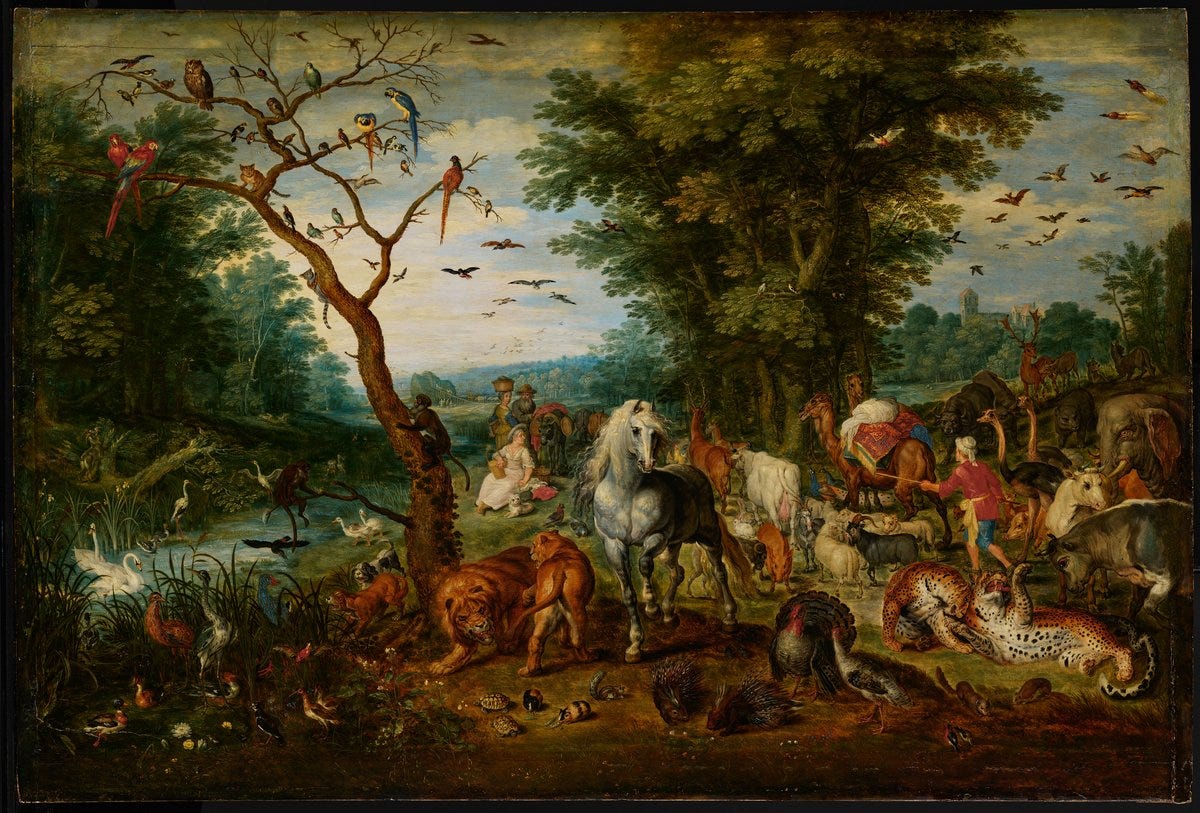
Genesis 2:19 reads: “And out of the ground the LORD God formed every beast of the field, and every fowl of the air; and brought them unto Adam to see what he would call them: and whatsoever Adam called every living creature, that was the name thereof.”
While Adam’s ultimate role was to dress and keep creation, his first was to catalogue it. He attended to what God had made, and by naming them, gave them their own place.
Murray in some way was playing the role of Adam in the creation of his dictionary. He was naming the animals, and every quotation slip was evidence that a word had been discovered, not invented, in the wild. Living in use. Murray’s task was to catalogue the shape of a word’s life across history, in the same way that Darwin’s was to catalogue the life of the finch across history, and to write it down with enough care that someone after him could come back to it.
Christ modelled the same orientation in Matthew 6:28–29:
“Consider the lilies of the field, how they grow; they toil not, neither do they spin: And yet I say unto you, That even Solomon in all his glory was not arrayed like one of these.”
Consider — here rendered in the Greek as καταμάθετε — means to learn thoroughly, to examine carefully, to fix one’s eyes upon. It’s not to engineer the lily or to place it; it’s to attend and bear witness to what God has already made, clothed in a glory that no human labour could improve.
This was the same task Murray set out to do.
It’s not incidental that English is the language of the modern world. In 1611, forty-seven scholars working in six committees produced the King James Bible. They were doing exactly what Murray would do 268 years later. They were handling the language with the care of men who believed both the language itself and what it encoded were profoundly holy. They were listening for what it could tell them.
William Tyndale had already given his life for the project. Strangled and burned at the stake in Vilvoorde in 1536 for the crime of translating scripture into English, his last words were, “Lord, open the eyes of the King of England.” Eighty years later, through God’s grace, the King’s eyes were opened, and the committee he commissioned refined what Tyndale had begun.


They worked for seven years on that translation. They read their translation out loud to each other concussively, over and over, because the Gospels were meant to be heard aloud in Church. The rhythm of the King James Bible — the cadence of its sentences, the way it falls on the ear — was not an accident of artistry. It was the product of men who understood that this language would be spoken and heard and that the shape of the sound mattered, and that each word was already sacred.
The result was a text so foundationally woven into the grain of English that you can’t even speak the language without echoing it. “The salt of the earth,” “a law unto themselves,” “the powers that be,” “fell flat on his face,” “the skin of my teeth,” “signs of the times,” “the writing on the wall,” “in the twinkling of an eye,” “see eye to eye” — these are all from the King James Version.
Its staggering how much of our shared language is straight from the pages of the KJV.
The King James Bible is so foundational to English that it’s impossible to separate the two. The KJV didn’t just use English; it made English. It gave the language its rhythm, its metaphorical grammar, the deep structures of thought that still govern how English speakers process moral seriousness, beauty, authority, and grief.


The Gospels did not merely travel in English — they became English, and the language absorbed the Word so completely that the two cannot be separated without killing both.
The real frontier of Britain’s empire was never the navy. The navy certainly delivered it. The East India Company also delivered it. But the payload wasn’t government, goods, or the capture of taxable lands. The payload was the English language itself, and the language carried the gospel inside of it so deeply embedded in the structure that it could hold the whole thing together. This was the greatest soft power the British Empire ever had, and it’s one that outlasted the colonies and the gunboats and the trading posts.
The British Empire is gone now, but the language is more dominant now than it was at the height of the Raj. More people speak English today than at any point in the history of the world. Every legal system built on English common law, every constitution drafted in English, every scientific paper published in English is still carrying the cadence of Tyndale and the King James translators and the structure of a language that was formed by the Gospels.


Webster, although he was a deeply religious man himself, reversed the order. He tended before he named. He planted, rearranged the garden, decided what should grow and where. The plants didn’t have their own logic for him. They had his.
There is a strain in American life — a beautiful one, and a dangerous one — that says: we can build it. We can build it better, faster, cheaper. We can skip the observation and go straight to the construction. We don’t need to know what the word meant in 1420. We need to know what it can do for us now. This instinct built the railroads, the skyscrapers, the internet, and the bomb. It is the instinct of Webster, and it is the instinct of Silicon Valley.
I live in that world. I am sympathetic to that world. But I want to insist — as clearly as I can, with the same seriousness that Tyndale gave his life for — that the ordering matters. You name the animals before you tend the garden. You observe before you build. You attend to creation before you impose upon it. And when you skip the first step, you get a language, a technology, a civilization that doesn’t know what it’s carrying.
But I don’t just want to talk about dictionaries. I want to talk about our final technology. From at least my approximation, the act of computing is the last technology that humans invented. And the computers themselves speak English.


Murray’s quotation slips were a sacred act of bearing witness because each one was evidence of a life. A person read a book, encountered a word, heard it, copied out a sentence, noted the date, noted the author, and mailed it to a man in a shed north of Oxford. The slip was proof that someone was alive and had used the word, and someone else was alive and meant something by it and catalogued it and sent it in. The Oxford English Dictionary is five million such proofs, in about forty-five pounds of them.
We are entering an era where the vast majority of language produced will not have come from or been originated by human hands. These are often seen as words without lives — fluid, grammatically impeccable words that are efficient. But they are words that were never spoken, often about nothing, and for transient reasons. The model does not attend. It does not consider the lily. It generates at scale, and the generation has no root.
We are producing language at a volume and speed that Murray and his army of volunteers could not have imagined. But the question that Murray asked of every word is: Who said this? When? What did they mean by it? And this increasingly has no answer. No one said it. No one meant anything. The word arrived without life attached.
I do not think this is cause for despair. I do think it is cause for attention.
It is not incidental that the final technology speaks English. The large language models, the systems that will carry us into whatever comes next, run on a language that was discovered across centuries by translators, by preachers, by naturalists, by poets who believed they were handling something holy. The training data is English. The weights, the statistical regularities that the model has internalized, are the regularities of a language whose fundamental architecture was shaped by the Gospels. The machine inherited the cadences of scripture without knowing what it carries. The vessel is still intact. And I do not think it is an accident — in terms of the provenance of creation — that this is the case.
The question is not whether the language survives in the machines. English has survived the Normans, the printing press, the Empire, Hollywood, and the internet. It will survive this. The question is whether we will recognise what the machines are carrying, and whether we will attend to it.

This is where the order matters. Go back to Genesis. Adam is given two tasks in the garden, and they arrive in sequence. The first is in Genesis 2:19 — he is brought every beast of the field and every fowl of the air, and he is asked to name them. The second is in Genesis 2:15 — he is told to dress the garden and to keep it. The naming and the sorting and the bearing witness to creation come before the cultivation of it. The catalogue is in some way the fundamental act of discovery, and it precedes the act of labour.
This is not an incidental detail in the text, because there are no incidental details in scripture. The order is the instruction. Before the act of making, there is the act of naming. Before the act of building, there is the act of seeing. Before the engineer, the naturalist. Before the American, the Englishman. Before you reshape the garden, you name the beasts.
We are building the most powerful language machines in the history of the world, in a language that was discovered, not invented — a language forged by translators who believed they were handling the Word of God. And we are building them in California.


Webster, although he was a deeply religious man himself, reversed the order. He tended before he named. He planted, rearranged the garden, decided what should grow and where. The plants didn’t have their own logic for him. They had his.
We are building the most powerful tools we have ever had. Our temptation is a very American one: to skip the naming and go straight to the tending. To build before we understand. To engineer the garden before we’ve catalogued the beasts.
The people who will build well with these tools — and build a future in which we all flourish — will be the ones who take up Murray’s posture before they take up Webster’s. They will attend. They will listen. They will handle the language with the care of men who believe the thing they are handling is sacred, even if they can’t yet articulate why.
In this way, in the garden, God gave us two vocations. We are both the naturalist and the engineer. But the naturalist comes first.
The pillar box outside Murray’s home is still there, still in service, but the slips stopped arriving long ago. What he started, however, did not stop. It cannot stop. The task of attending to our language and to the creation it describes is not optional. It is the first task given to mankind, and it remains the first task given to our final technology. The work before us is not only to build a new thing, but to attend to what we have been given. And that starts with our language. To do what Murray did. To do what the KJV translators did. To do what Tyndale died for. To handle the language as we should handle the rest of creation — with the care of men who knew they were handling something holy. To name the beasts before we tend the garden.
To discover before we engineer. To bear witness to creation, and to the Word that still moves within it.
this is beautiful 🙏🏾
It also demands a posture of humility